
Mono- vs, Polycrystalline Solar Panels
There are two main categories of photovoltaic solar panel options to consider being monocrystalline (mono) and polycrystalline (poly). Contrasts between these panel types are explained below.
The photovoltaic effect is both a chemical and physical process that generates voltage or electric current in a photovoltaic cell when exposed to sunlight. This is the effect that makes solar panels useful, since this is how the cells within a panel convert light sun to energy.
Silicon is the main element used in solar panels as it is both durable and widely available. Both mono and poly solar panels are good choices, but there are key differences between the two technology types to consider. The main difference between the two technologies is the type of silicon solar cell they use: mono solar panels have solar cells made from a single crystal of silicon, while poly solar panels have solar cells made from many silicon fragments melted together.
Monocrystalline solar panels
Monocrystalline solar panels are generally thought of as a premium solar product. The main advantage of mono panels are higher efficiencies. To make solar cells for mono panels, silicon is formed into bars and cut into wafers. These types of panels are called “monocrystalline” to indicate that the silicon used is of a single-crystal. Being composed of a single crystal, the electrons that generate a flow of electricity have slightly more room to move when compared to a fragmented cell. Therefore, mono panels are generally more efficient their poly panels.
Polycrystalline solar panels
Polycrystalline solar panels are also made from silicon and generally have lower efficiencies than mono panels, however, they have lower costs from the production process of combining melted fragments of silicon to form the wafers for the panel. Because there are many crystals in each cell, there is less freedom for the electrons to move when compared to mono panels. Therefore, poly panels generally have lower efficiency ratings than mono panels.
Lithium ion vs. lead Acid Batteries
Require our own comparison, but will be similar to table below:
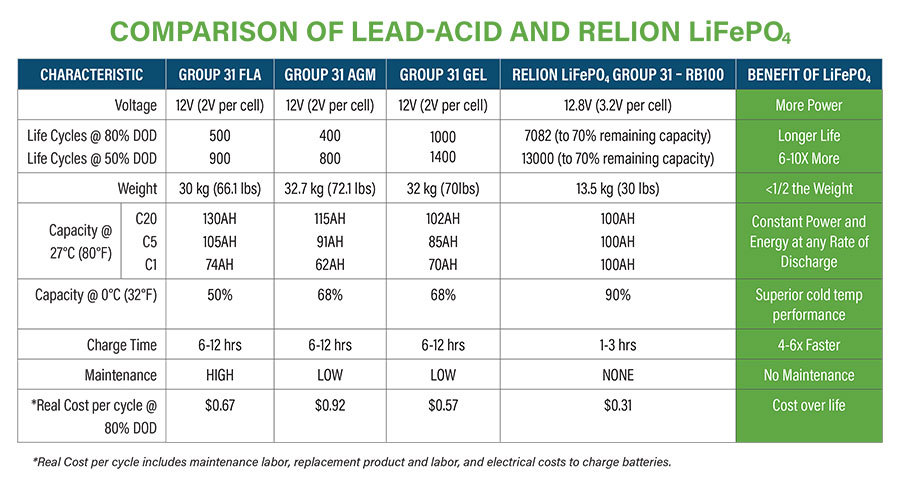
Augment with text paragraphs (include cost / benefit over lifetime analysis)
Grid-tied Systems
A grid-tie inverter converts direct current (DC) into an alternating current (AC) suitable for injecting into an electrical power grid, normally 230V RMS at 50 Hz for South Africa. DC current could be from renewable sources such as solar PV panel as well as batteries. Also referred to as “tied to grid” or “grid tie systems”.
Certain municipalities and Eskom pay for electrical power that is injected into the grid where the producer meets their required criteria for the area.
Main advantages of a grid-tie systems are efficiency, simplicity in design and relatively low cost to install as no batteries are required. Conversely the disadvantage is that during power outages, grid-tie inverters have no grid reference to synchronise to and switches off.
Major components required for off-grid systems are solar PV panels coupled with an inverter/(s). The system will only generate power during the day – with sufficient light from the sun – which means that energy required at night will still be obtained and paid for from the municipal or Eskom network.
Grid-tied systems are the most commonly uses in South Africa at the moment, mainly due to the return on investment it provides the user to save money on electricity bills, as well as generating their own green energy and reducing their carbon footprint in the process.
Own infographic
Off-grid Systems
This is a solution for areas where the grid is wholly-unstable, no grid connection exist or instances where a connection is simply too expensive to install/waiting list for installation too onerous
Major components required for off-grid systems are: solar PV panels; battery bank to store and provide power requirements; inverter to provide AC power and charge batteries from the sun. Optionally a generator can be used to supplement battery charge in bad weather conditions.
Importantly, off-grid inverters are designed to work alone and cannot synchronise with the grid.
Own infographic
Hybrid Systems
These are the most advanced and user beneficial systems. Hybrid systems are per the definition of the word: combinations of renewable energy sources (e.g. solar PV panels or small wind turbines) or other sources (e.g. generators) which are installed and configured/automated in a way to meet user needs and expectations.
Major components required for hybrid systems are: solar PV panels; battery bank to store and provide power requirements; inverter to provide AC power and charge batteries from the sun. The major difference between hybrid and off-grid systems are the abilities of the inverter and therefore hybrid inverters are generally more costly. Again an optional generator can be used to supplement battery charge in bad weather conditions, however, in hybrid systems the grid should be applied to this first and a generator would be a second fail-safe.
The major advantages of hybrid systems are the ability to function firstly as a cost saver and use solar power during the day and then, depending on the size of the battery bank, the user can elect to use batteries either at night, or save battery power to rather use during load shedding or any other power outages. A large enough battery bank, although costly, will effectively remove a user from grid-dependence.
During any power outage a hybrid inverter and battery bank will also function as an uninterruptable power supply (UPS) system, being far more robust than a generator which required time to start, warm up and synchronise to the grid. Where a generator has been installed previously the installation can suffice with a smaller battery backup requirement, as the generator will then take over from the batteries when their charge becomes low (all controlled by the hybrid inverter). For the sake of clarity, where power fails in daytime, hybrid systems will first use energy from solar panels before using batteries and therefore can provide electricity for extended periods of outage time, e.g. to allow time consuming fixes to electrical cable or substation infrastructure.
Own infographics